
Newsletter no. 3
Frank Duveneck’s importance to American art rests not only on his own achievement but on the extraordinary range of artists shaped by his teaching. The painters represented here belong to both generations associated with him: those who studied in Europe during the 1870s and those trained later in Cincinnati. Together they carried Munich realism and, later, Impressionist tendencies into American art, adapting his principles to widely different artistic goals.
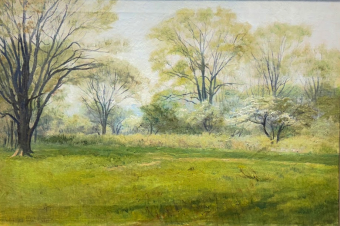
Among the European circle, two artists in our collection demonstrate the diverse directions Duveneck’s instruction could inspire. Charles Abel Corwin (1857–1938) became a central figure in Chicago’s artistic life, transmitting Munich-trained tonal painting to a rapidly developing Midwestern cultural center. His landscape Hawthorne and Willow (c. 1899) reflects this mature synthesis. A luminous meadow dissolves into softly articulated trees, organized through tonal harmony rather than linear detail. The restrained palette of greens, pale blues, and muted earth tones reveals fidelity to Munich methods, while the fluid brushwork anticipates American Impressionism. Corwin transforms an unassuming urban-edge scene into a contemplative landscape shaped by atmosphere and light.
Newsletter no. 2
During the nineteenth century, regions of North Africa and the eastern Mediterranean captured the imagination of artists in Europe and the United States with unprecedented intensity. Expanding trade routes, colonial encounters, and increased mobility exposed Western audiences to cultures whose architecture, visual traditions, and social customs appeared markedly different from those at home. Painters encountered these worlds either indirectly, through imported objects and imagery, or directly, by traveling abroad to study and work. Because extended journeys into the Middle East or Asia were often impractical, many artists gravitated toward cities that operated as cultural crossroads, places where Eastern and Western traditions coexisted visibly and accessibly. Venice and Cairo emerged as two of the most significant of these sites.
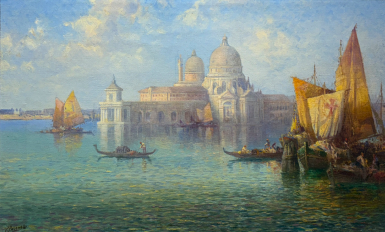
Venice had long occupied a singular position in the artistic imagination. Celebrated since the Renaissance for its emphasis on color and atmosphere, the city offered a visual experience shaped by water, light, and architectural density. By the late nineteenth century, American artists studying in Europe found in Venice an environment that encouraged painterly freedom and tonal sensitivity. For Cincinnati artists in particular, the city became a vital extension of academic training abroad. In Venice, Santa Maria, Victor Casanelli balances historical Venitian subjects with contempoaryary life. Gondoliers, bridges, and narrow canals appear not as isolated motifs but as elements within a living environment shaped by centuries of exchange.
Newsletter no. 1
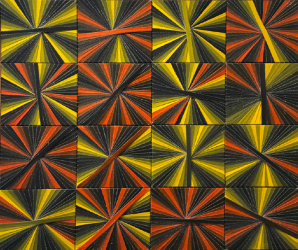
The rise of Op Art in the 1960s is often framed as a sudden rupture within American modernism, a dramatic turn away from the emotive surfaces of Abstract Expressionism and toward the perceptual mechanics of seeing. Yet long before the Museum of Modern Art’s 1965 exhibition The Responsive Eye crystallized the movement in the public imagination, artists across the country were already experimenting with the visual dynamics that would come to define it. Among the most compelling of these early figures was Margaret Wenstrup, a Kentucky-born and Cincinnati-trained painter whose work in the 1950s and 1960s developed an organically American form of optical abstraction.
Her approach fused the clarity of Precisionism, the geometry of folk art, and the rigor of perception-based modernism. Through this synthesis, she produced paintings and mixed-media works that stand as significant contributions to the broader story of twentieth-century abstraction.